I use a simple model when thinking about how value moves across the internet:
- ValueType defines what is moving – dollars, euros, stablecoins, digital deposits, whatever.
- TransferType defines how it’s moving – bank transfer, blockchain, card network, protocol, whatever.
These abstractions help map the mechanics. But I’ve been trying to find the word for years that describes the expansion of the current technical stack, and derivations feels like the right word. One of the unique benefits of Brale’s recent fundraise, is that it gave me the opportunity to talk a lot about this to people who challenged and help fine tune my thinking here.
The ValueType / TransferType is also an anchor of the Brale API that simplifies all of this from a developer’s perspective – a train of thought that only took me ~20 years to arrive at. Sometimes things take time.
A derivation isn’t a new invention. It’s an evolution. A familiar idea re-emerges in a new technical or economic context, reshaped by what’s possible now.
Think about everyday payment systems. When they were created, we didn’t have the consumer internet and Merkle trees didn’t even exist yet. ACH was introduced in 1974. The first paper on Merkle trees wasn’t published until 1979. Their use as cryptographic structures, and their role in distributed networks, wasn’t even imagined.
Fast forward: Merkle trees are now the backbone of blockchains, which are, in many ways, derivations of traditional settlement networks, just with different constraints, bandwidth, and trust assumptions. We no longer work in batch files. Bandwidth is effectively infinite.
The financial system is full of these derivations. Most of today’s rails extend from the last generation’s infrastructure. But protocols and blockchains create room for grand derivations, ones that change the surface area of value movement entirely.
Major Value Derivations Shaping the Path Forward
There are three major derivations redefining the value layer today:
1. Stablecoins as Liquidity Derivations
Stablecoins like USDC and USDT are the new cash equivalents – accessible, digital, and programmable. In a previous iteration, ACH served as the off-ramp. Today, these tokens serve a similar role: they bridge apps, exchanges, and banks with liquidity that didn’t exist before.
They are ValueTypes that function globally, instantly, and without banking hours. Tapping into the virtually limitless depth of stablecoin liquidity is much faster than in traditional markets. It’s even going a step further, where you have things like stablecoins able to tap into things like Bitcoin, which is, arguably, the deepest permissionless liquidity moat on the planet. $1T is an astounding amount of value to have the opportunity to program against.
These tiny, seemingly innocuous features and products represent seismic shifts in workflows.
2. Protocols as Transfer Derivations
Blockchains and interoperability layers (like LayerZero, Axelar, or even Solana itself) are TransferTypes. They aren’t just payment rails, they’re general-purpose routers, capable of moving assets, states, or instructions across economic systems for any purpose.
These are fundamentally new transfer mechanisms, but they borrow from legacy concepts: routing, clearing, finality. They just compress them into blocks, mempools, and consensus layers. Different compute, same idea.
3. Legacy Rails Going Onchain
Every fiat currency and bank rail already fits into the model. They start offchain — through wires, SWIFT, ACH — and increasingly move onchain. Through tokenization and interop protocols, these assets now gain the advantages of protocols:
- Infinite bandwidth
- Instant settlement
- Global reach
We’re watching in real time as tokenized dollars, euros, and pesos become not just endpoints — but inputs into programmable, multi-network ecosystems.
Simplicity & Speed Emerge
When you accept these derivations, you start to see a simple model. Before:
App ➝ ACH ➝ App ➝ ACH ➝ App
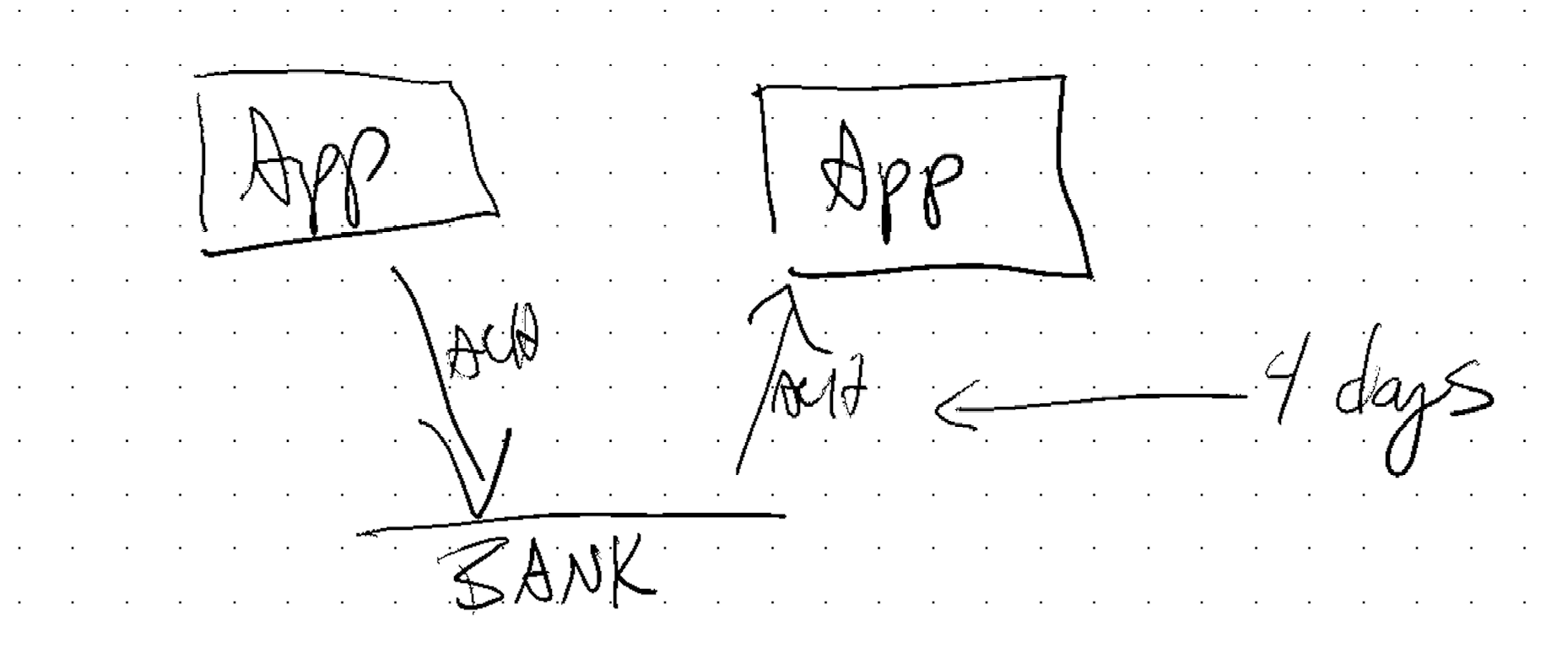
Now: App ➝ Protocol ➝ App
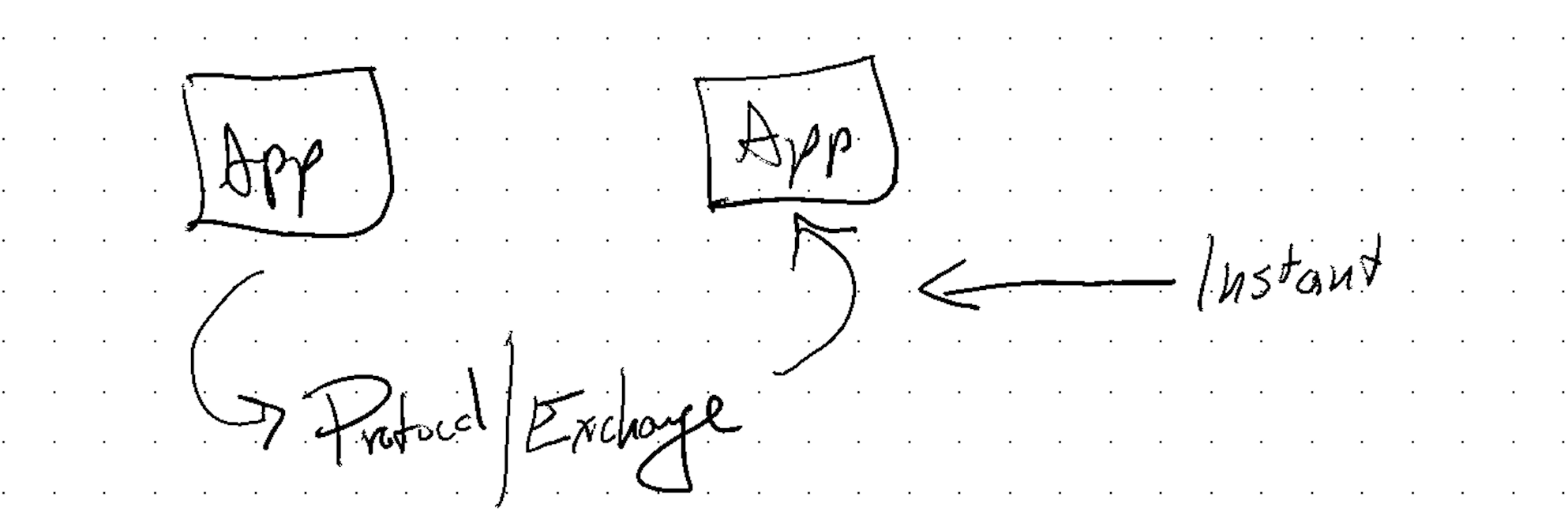
A transformation happens: Suddenly, value can move instantly and globally, mostly permissionless. It changes who can participate. It creates liquidity for projects that don’t have to ask permission. The barriers to experimentation fall away. ACH was a traditional bridge from one place to the other, stablecoins on a protocol end up being the great deviation. It turns into massive acceleration because everything is instant, global, and on.
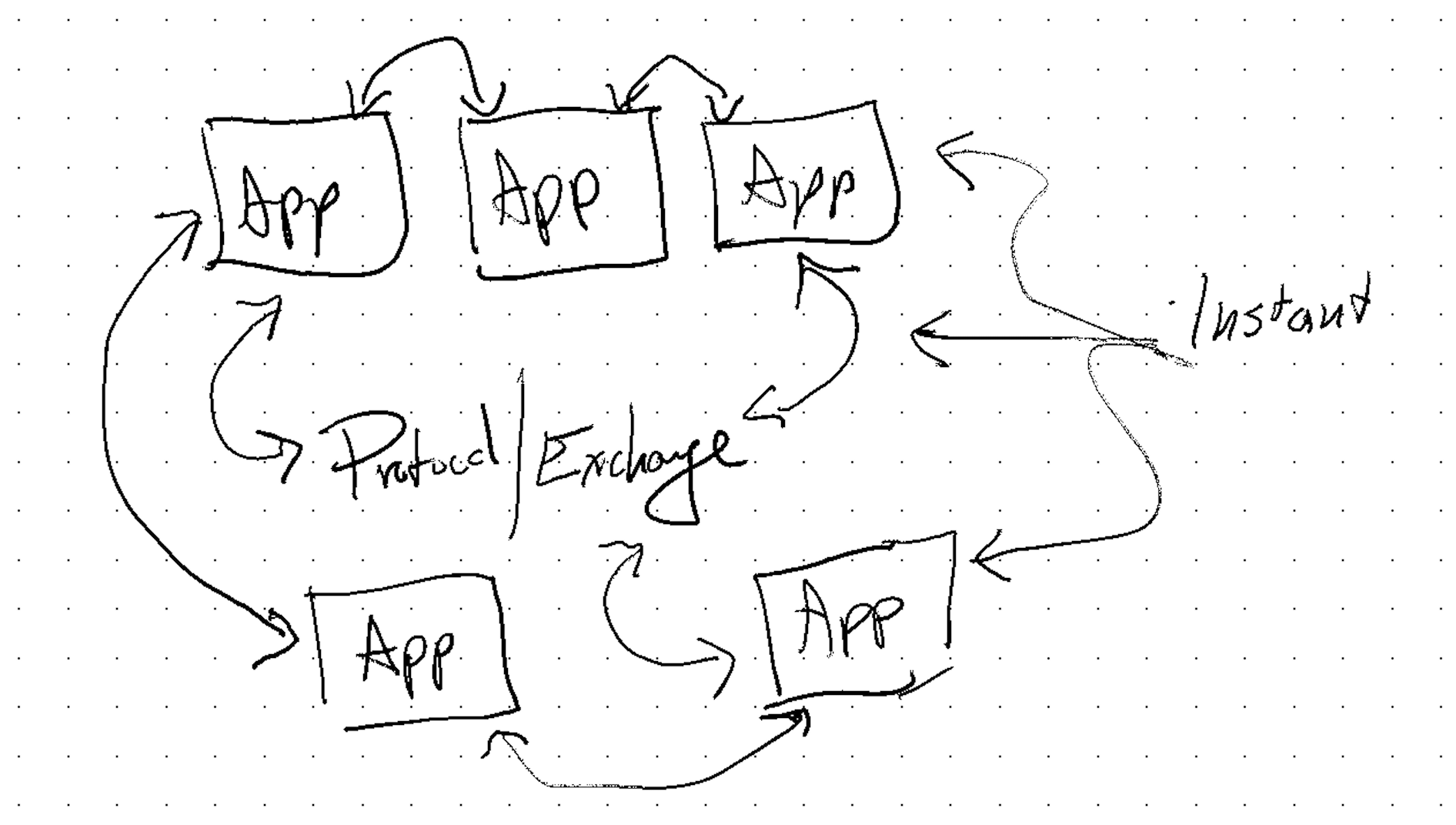
That’s how you get global acceleration. Computing concepts like RAM, ROM, Edge, Hard Drives, and otherwise are starting to play into these different value streams and to make it all better, everyday there is a new ecosystem with a new feature set. Value only sits when a specific system is chosen because of specific attributes or rules.
Derivations Connect. They Don’t Replace
Stablecoins and protocols don’t operate outside the system. They are step-function derivations of the last thing and they’re compatible with it. USD -> SBC -> USDC and right back in any variation you can dream up and go deploy works just fine.
Today, a stablecoin wallet can settle back into a bank account running on an FIS core. That’s not disruption. That’s interpolation. No cores get turned off as the bandwidth of money goes up. Everything keeps humming along.
It looks like a bridge, but it isn’t. The marketing language in blockchain has always leaned on words like “bridge” or “on-ramp,” but those are metaphors of distance. What’s happening here is closer than that. It’s simply a move. It’s a transfer. Everything is a transfer.
When you move a file between folders on your computer, you don’t “bridge” the file. You just move it. There’s a log somewhere that records the move, and that’s how the computer knows where to show it. Stablecoins work the same way if designed well: a value packet is picked up in one context and placed in another. The metadata is what makes it legible.
The Coming Decades of Access
If history is our guide, the next 10, 20, 30 years will do to money what the last 30 did to publishing and commerce. Looking back a century makes the pattern obvious: the creation of the Fedwire clearing system in 1918, the arrival of the consumer internet in the 1990s, the rollout of digital bank cores in the 1980s and 2000s, the rise of mobile phones in the 2000s, Bitcoin in 2009, and stablecoins in 2014.
Looking forward a century, we’re probably still in the footnotes of the most important things to happen. But all the enabling multipliers and required derivations for step-function changes that will reshape the financial landscape are already in place. Everyone wants to believe it’s their company or project that makes it possible. Maybe it is. More likely, it’s many projects, many companies, and many generational winners.
In the same way HTTP let anyone publish a webpage, stablecoins and protocols are letting anyone publish to the value layer, to create programmable, composable, stable economic interactions that reach anyone, anywhere. Global by default. Always on by default. Infinitely customizable for virtually free. The coming decades will bring more ecosystems, more blockchains, more stablecoins, more websites, more devices, faster networks, and so much more.
Many Things all at once
Derivations matter less individually than in constellation. Together, they compound. That’s why the future isn’t coming, it’s already here. Our job is simply to build on it.
I remind myself everyday our job at Brale is to help others build with these new tools. To reduce friction, increase liquidity, get new ecosystems and new products to market faster so they can leverage the most powerful derivations of our generation.